

NPRM for Part 108 on BVLOS Operations of UAS in the United States
Currently in the United States, only regulations for VLOS operation of UAS (Part 107) have been established; for BVLOS operations, permits are issued on a case-by-case basis following individual review. As a result, it takes a long time to actually begin operations, and the costs are extremely high, creating a barrier to business expansion using UAS.
To resolve this situation, the establishment of regulations for BVLOS operations of UAS (Part 108) is being expedited. NPRM for Part 108 was published in August 2025, and public comments are currently being collected. The final version, incorporating these comments, is scheduled to be established in 2026.
Part 108
Part 108 is divided into the following subparts.
・Subpart A General
・Subpart B Operating Rules
・Subpart C Operations Personnel
・Subpart D Permitted Operations
・Subpart E Certificated Operations
・Subpart F Maintenance and Alterations
・Subpart G Procedures for Unmanned Aircraft System Airworthiness Acceptance
・Subpart H Design and Testing Requirements for Airworthiness Acceptance
The following is a summary of the key points contained in the NPRM for Part 108.
Requirements are defined in 5 categories based on the population density of the operational area
When operating in areas with high population density, more risk mitigation measures are required. Population density is assessed using data from Oak Ridge National Laboratory’s “LandScan USA” and is defined using a smaller mesh size than the classification categories for DID areas in Japan. Therefore, for example, when flying in a city with low population density but over areas with high local population density—such as the surroundings of major stations—Part 108 requires many risk mitigation measures.
・Category 1: Farther than 1 status mile from any cell of 10 people or higher.
・Category 2: Within 1 statute mile of a cell of 10 people or higher, and not within a Category 3, 4 or 5 area.
・Category 3: Within 1 statute mile of a cell of 25 people or higher, and not within a Category 4 or 5 area.
・Category 4: Within 0.5 statute miles of a cell of 100 people or higher, and not within a Category 5 area.
・Category 5: Within 0.5 statute miles of a cell of 2,500 people or higher.
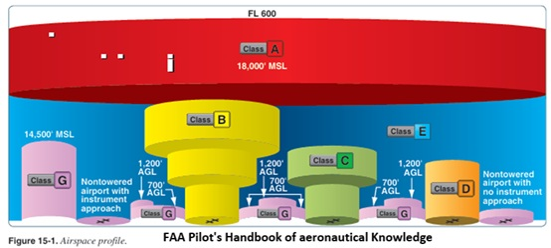
Requirements for collision avoidance are established based on the 5 categories listed above and the airspace (see areas A–E and G in the figure below)
Requirements for strategic collision avoidance, monitoring for deviations from flight plans, and non-cooperative collision avoidance (the ability to avoid other aircraft that are not transmitting their position) are specified according to each category and airspace.
For example, in Category 1, which has the lowest population density, if the airspace class is D, strategic collision avoidance and monitoring for deviations from flight plans are required; however, if the airspace class is G, these requirements do not apply.
Note that regardless of the category or airspace, the ability to broadly transmit self-positioning information and the installation of Remote ID are required.
There are also other requirements regarding operators.